
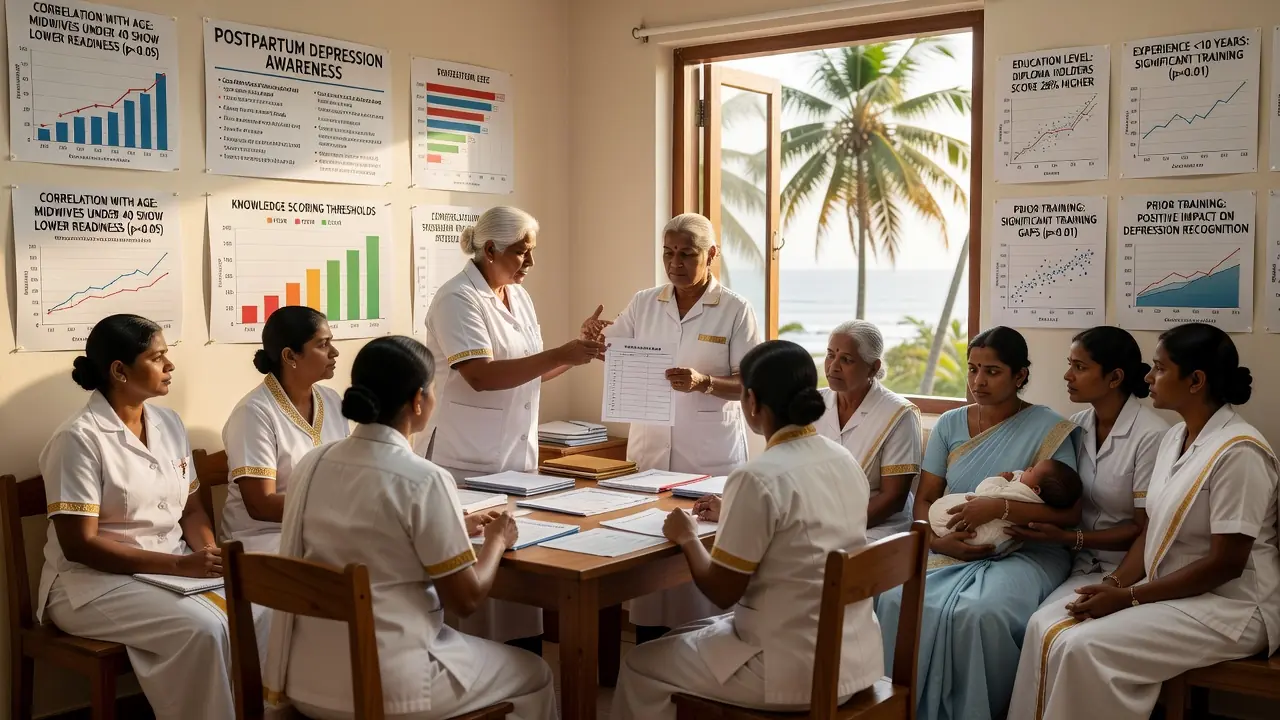
A cross-sectional survey of midwives in Sri Lanka's Jaffna district found that more than half had only a moderate understanding of postpartum depression and its clinical management. The study, published in BMC Nursing, surveyed 186 of 215 eligible midwives and linked stronger knowledge to age, education level, experience and prior training.
What the study measured
Researchers distributed a self-administered questionnaire covering socio-demographic details, service-related factors, and specific knowledge about postpartum depression and how to manage it. The tool was developed with supervisory input, checked for clarity, and pretested on five midwives who were then excluded from the main sample. Knowledge scores were converted to percentages and sorted using standard thresholds: 80-100% counted as good knowledge, 60-79% as moderate, and anything below 60% as poor. With 186 responses out of 215 eligible participants, the study achieved an 86.5% response rate, a relatively strong return for this kind of survey.
Who scored higher, and why it matters
Most respondents were between 31 and 40 years old and had completed Advanced Level midwifery training. Yet the statistical analysis - all associations significant at p values below 0.05 - showed that midwives aged 36 to 50, those holding diploma-level qualifications, and those with ten or fewer years of professional experience were more likely to demonstrate good knowledge. This pattern suggests that formal continuing education and recent exposure to the subject, rather than years on the job alone, may be the stronger drivers of competence. Because midwives are frequently the first point of contact for new mothers in community settings, their ability to recognize warning signs carries direct implications for maternal mental health, infant development and broader family well-being, particularly given that postpartum depression is estimated to affect 10-15% of women after childbirth.
Limits of the findings
The authors are explicit that this is a descriptive, cross-sectional snapshot limited to one district, so it does not establish changes over time or prove cause and effect. The results describe the surveyed midwives in Jaffna and should not be generalized to other regions or health systems without further research. Even so, the authors note that gaps persisted in specific areas of recognizing and managing the condition, despite most participants falling into the "moderate" knowledge band rather than "poor."
What the researchers recommend
Based on these patterns, the study calls for targeted educational interventions and ongoing professional development programs aimed at strengthening midwives' capacity to identify and manage postpartum depression. The stated goal is to improve maternal mental health outcomes in the region by closing the specific knowledge gaps the survey identified, rather than assuming general midwifery training alone is sufficient.