
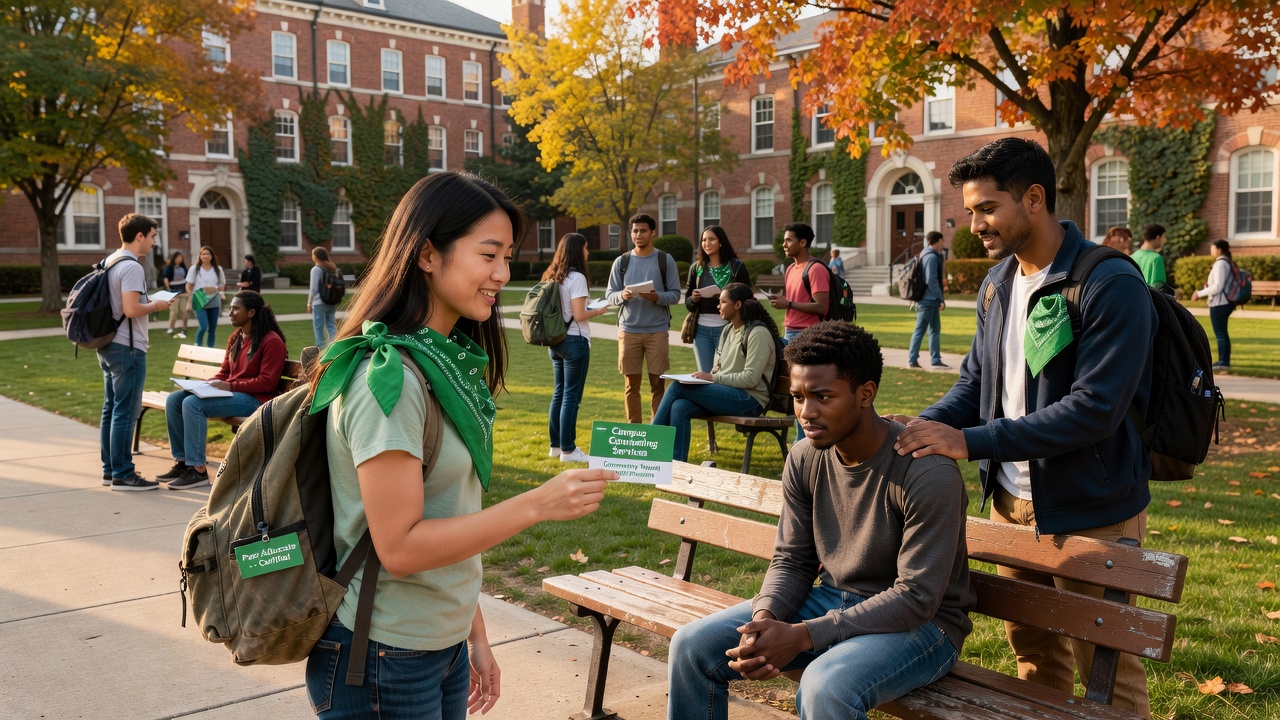
American International College has introduced The Green Bandana Project, a peer-to-peer mental health initiative that trains students to recognize warning signs of emotional distress in classmates and guide them toward professional support. The program, now active at more than 90 schools nationwide, aims to normalize conversations about mental health on campus and reduce the stigma that often keeps students from seeking help.
How the program works
Students who complete the training receive a green bandana, which they attach to a backpack or wear visibly on clothing. The bandana signals to peers that the wearer has been trained to recognize signs of suicidal ideation or mental health crises and can point classmates toward appropriate resources. Participants also carry resource cards listing campus and community support services, giving them a concrete tool to hand to someone in distress rather than relying on memory alone.
Jennifer Carranza, the program coordinator at American International College, described the initiative as one avenue for students to engage in suicide prevention advocacy and build confidence in supporting peers. Kaelly Ryan, PA-C, executive director of Health Services and Student Wellness at the college, said the visible marker is meant to make trained students approachable, so classmates know whom to turn to during a difficult moment.
Why the issue matters
Suicide remains the second leading cause of death among people ages 10 to 24 in the United States, according to the context provided by the college. That statistic underscores why colleges and universities have increasingly turned to peer-support models, which rely on the idea that students often confide in classmates before approaching a counselor or health office. A peer wearing a recognizable symbol can lower the barrier to that first conversation.
This approach does not replace clinical care. Trained students are not counselors, therapists or medical professionals; their role is limited to recognizing signs of distress and connecting peers with professional resources, such as campus health services or community mental health providers. The resource cards serve as a bridge, directing students to established services rather than offering treatment themselves.
What the initiative can and cannot do
Programs like this one are designed to complement, not substitute for, professional mental health infrastructure on campus. Their effectiveness depends on students actually completing training, consistently wearing the bandana, and knowing how to make appropriate referrals. Because the program is peer-driven, its reach is limited to the students who choose to participate, and its impact on long-term outcomes such as reduced suicide rates has not been independently measured in the information provided.
Ryan said the college intends to expand awareness of available mental health resources both on campus and in the surrounding community, a signal that the bandana initiative is part of a broader institutional effort rather than a standalone fix. Students or families seeking more detail about how the program operates can consult the national project's published materials for additional context.