
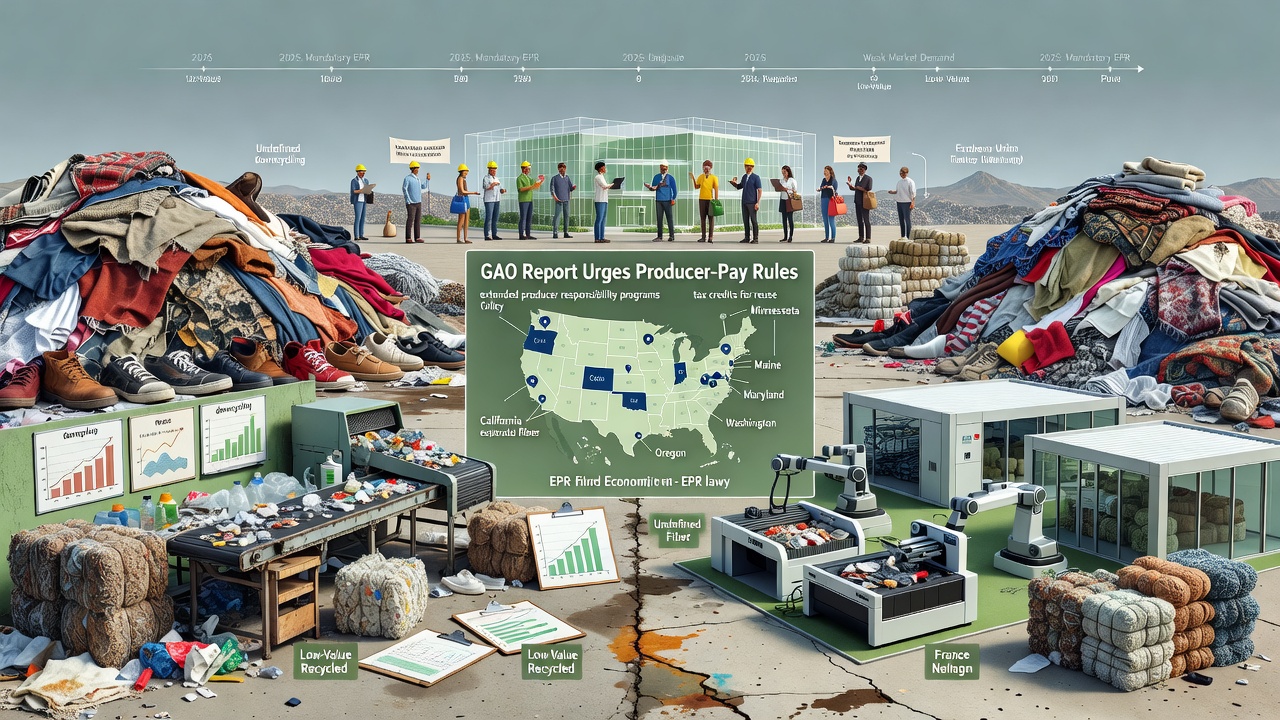
A new Government Accountability Office report examines why the United States lacks a functioning system for reusing and recycling textiles, and outlines policy options-including extended producer responsibility programs and tax credits-that could help close the gap. The federal watchdog agency found that infrastructure, demand and data shortfalls remain the central obstacles to building a circular textile economy nationwide.
What GAO Found
Building on earlier work from 2024, GAO reviewed legislation, federal agency records and academic research, and interviewed government officials, industry representatives, academics and nonprofit groups. Investigators also visited Oregon, Washington, France and the Netherlands to examine private-sector circularity efforts firsthand. The report describes textiles as part of a vast global sector spanning fiber sourcing, yarn production and manufacturing of goods such as apparel, carpets, footwear and towels.
GAO identified the collection, sorting and recycling infrastructure gap as the most significant barrier. Facilities built to recycle materials like PET plastic or paper generally cannot process textiles because of contamination risks, while fabric blends, dyes, zippers and other components complicate recycling further. The agency also pointed to weak market demand for recycled textile material, inconsistent data collection, and a lack of standardized terminology-noting that even basic terms like “reuse” and “downcycling” lack agreed-upon definitions.
Policy Options on the Table
To address these gaps, GAO highlighted extended producer responsibility (EPR) programs as a leading option. Under this model, producers help fund the collection and recycling of their products at the end of their useful life. Several states-California, Colorado, Maine, Maryland, Minnesota, Oregon and Washington-already have or are implementing EPR laws for packaging, and the European Union plans to apply similar requirements to textiles starting next year. GAO suggested that pairing an EPR approach with tax credits could offset costs for businesses that invest in textile reuse or waste-reduction efforts.
Industry stakeholders interviewed by GAO generally favored a federal policy framework over a patchwork of state rules, arguing it would simplify compliance and coordination. However, GAO cautioned that a national approach would require additional federal resources, interagency coordination and confirmation of the government's legal authority to act.
Practical Implications and Limits
The report frames textile circularity as a multi-stakeholder challenge involving Congress, state legislatures, manufacturers, recyclers, nonprofits and consumers alike. While GAO outlines potential economic benefits-including new jobs in repair and recycling-it stops short of recommending a single path forward, instead presenting options for policymakers to weigh. The findings suggest that without stronger infrastructure, clearer definitions and sustained demand for recycled materials, progress toward a circular textile economy in the U.S. is likely to remain incremental.