
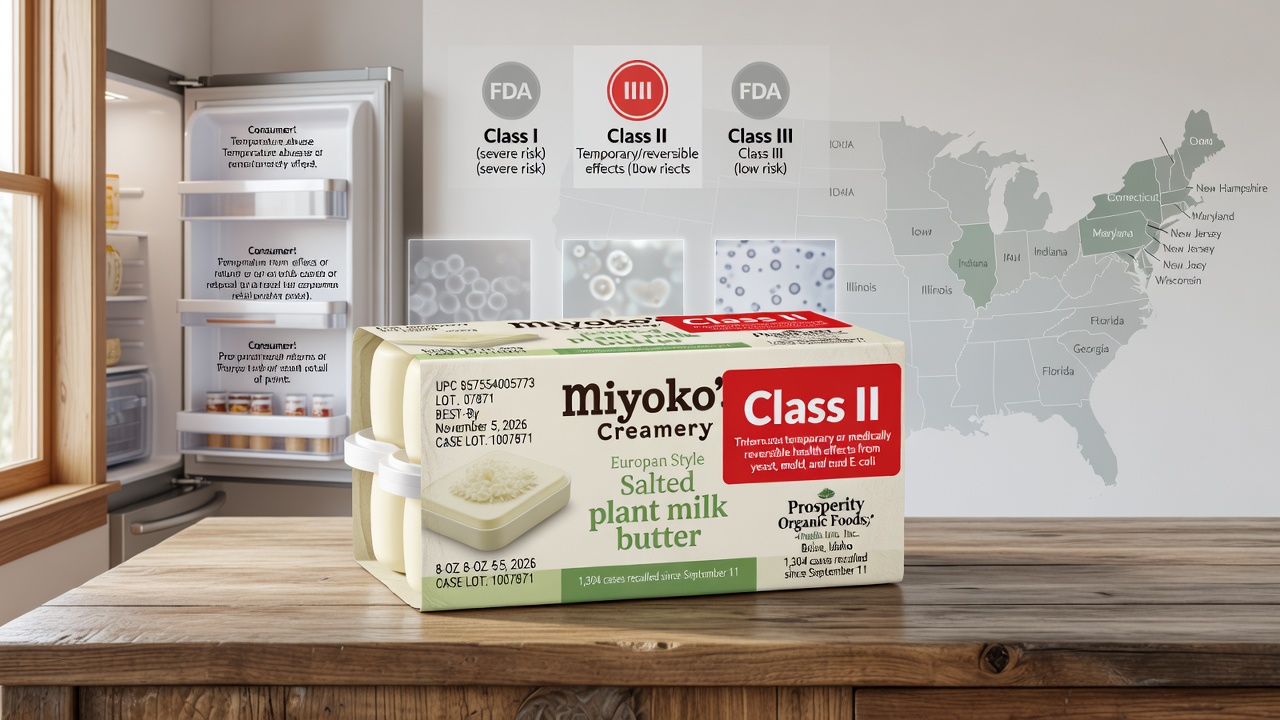
The U.S. Food and Drug Administration has classified a recall of Miyoko's Creamery European Style Salted Plant Milk Butter as a Class II risk, meaning the product may cause temporary or medically reversible health effects. The recall, initiated by Boise, Idaho-based Prosperity Organic Foods, Inc., covers 1,304 cases and was first announced September 11.
What triggered the recall
The affected butter was pulled from distribution after testing or internal review identified the presence of yeast, mold, and E. coli. These are distinct contamination concerns: yeast and mold typically signal spoilage or improper storage conditions that can compromise shelf-stable or refrigerated products, while E. coli is a bacterium that, depending on the strain, can cause gastrointestinal illness ranging from mild discomfort to more serious infection. The company has not publicly detailed which specific E. coli strain was found, and no additional laboratory findings were included in the recall notice.
Understanding the FDA's Class II designation
The FDA sorts recalls into three risk tiers. Class I applies to situations with reasonable probability of serious health consequences or death. Class III covers violations unlikely to cause any adverse health reaction. Class II, the category assigned here, sits in between: it indicates a product that could cause health problems that are temporary or medically reversible, rather than severe or life-threatening. This classification does not minimize the recall but places it within a defined risk framework that guides how urgently consumers and retailers should respond.
Identifying the affected product
The recalled butter is sold in six-packs of 8-ounce units under UPC 857554005773. Consumers can confirm whether they have an affected package by checking the lot number and best-by date printed on the carton, 07871 with a best-by of November 5, 2026, or the case lot number 1007871 with the same date. The product is perishable and requires refrigeration or freezing, which is itself relevant to the contamination risk, since temperature abuse during storage or transport can accelerate microbial growth.
Distribution reportedly extended to Connecticut, Florida, Georgia, Iowa, Illinois, Indiana, Maryland, New Jersey, New Hampshire, and Wisconsin, though the recall notice does not specify exact retail locations within those states.
Practical steps and limits of current information
Consumers who purchased the identified lots are generally advised in recall situations to avoid consuming the product and to check with the point of purchase regarding return or disposal guidance, though this article does not substitute for instructions issued directly by the company or retailers. No information was provided in the source material about confirmed illnesses linked to this specific recall, so it remains unclear whether any adverse health reports have been received. As with any food safety classification, the Class II designation reflects a risk category assigned by regulators based on available evidence, not a confirmed count of affected consumers.