
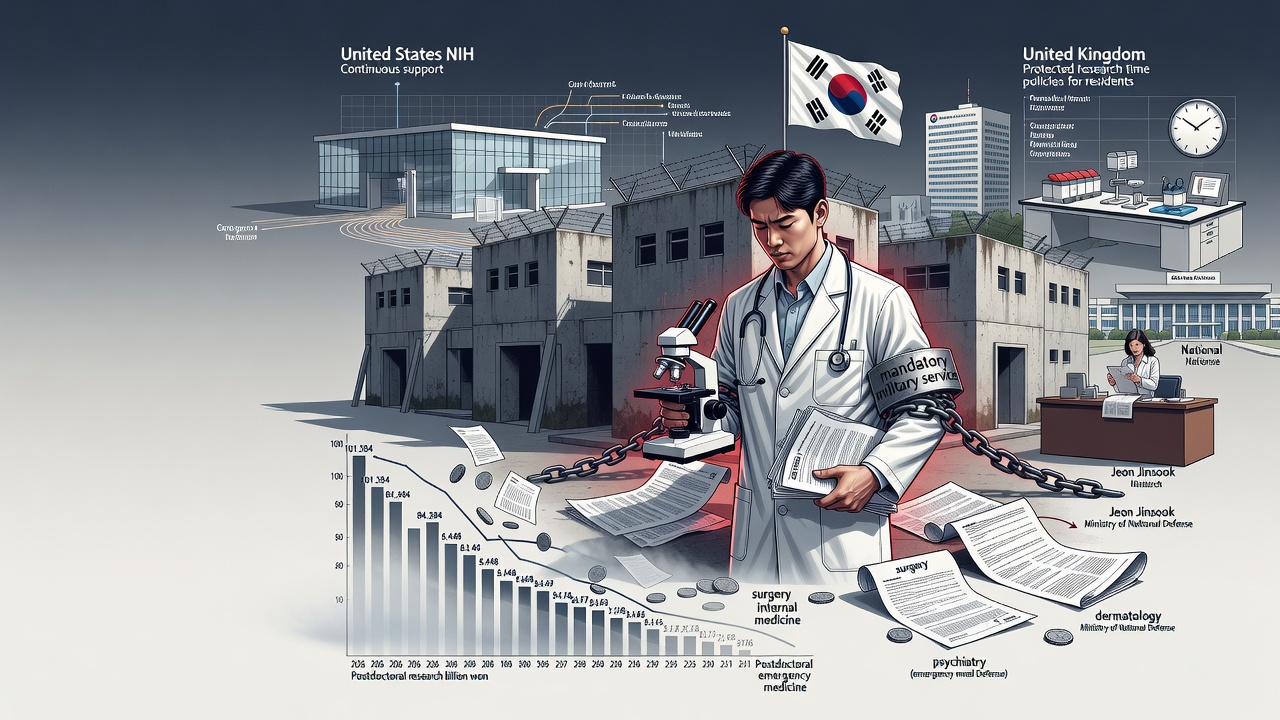
A South Korean lawmaker's review of government data shows that nearly three-quarters of male graduate students in a state-backed physician-scientist training program are enrolled in medical specialties the military has designated as mandatory service fields, putting their research work at risk of a lengthy pause. The disclosure comes as the government's own postdoctoral research support budget for these trainees is set to shrink next year, raising questions about whether current policy can retain the scientists it trains.
What the data shows
According to figures submitted by South Korea's Ministry of Health and Welfare and the Korea Health Industry Development Institute to lawmaker Jeon Jinsook, 47 of 64 male students in the "Convergence Program for Training Physician-Scientists" - about 73.4% - were classified as of October 26 as training in medical specialties the Ministry of National Defense has deemed essential for military service. Because of that classification, these trainees face restricted access to the military's specialized research personnel track, a program designed to let scientifically trained conscripts continue research-related work during service. Physician-scientists who instead serve as standard military doctors see their research activity halted for 36 months.
The list of specialties designated as military-required has expanded sharply, from two in 2024 to 12 in 2025 and 13 in 2026, now including fields such as internal medicine, surgery, emergency medicine, psychiatry and dermatology, among others. Lawmakers and trainees have also flagged a procedural problem: the ministry announces which specialties are designated only about four months before enlistment, leaving little room for long-term career or research planning.
A shrinking budget and a narrow talent pool
South Korea trains an average of just 83 non-clinical physician-scientists annually, roughly 2.7% of the 3,058 students who graduate from the country's medical schools each year. The government has committed to investing a total of 515.3 billion won between 2024 and 2032 in postdoctoral research, international training and joint research for this group. Yet the proposed 2026 budget for government-funded postdoctoral support - 84.448 billion won - represents a 16.7% cut, or 16.936 billion won less than this year's 101.384 billion won allocation.
Separately from the military-service bottleneck, researchers who complete doctoral training also encounter structural limits on becoming independent investigators, since support tends to focus on individual projects rather than sustained career development, and medical institutions often lack dedicated research time or staff. The Global Physician-Scientist Training Program, which funds postdoctoral research, is structured as a time-limited R&D project, so what happens to participants after it concludes remains unclear.
How other countries structure support
The article's sourcing points to two comparative models. In the United States, the National Institutes of Health has supported physician-scientists continuously from the postdoctoral stage through independent research careers since 1964. In the United Kingdom, formal policies protect research time directly within clinical training: 25% of working hours for residents and 50% of working hours after a doctoral degree, with salary support and replacement staff used to cover clinical duties during that protected time.
What lawmakers are proposing
Jeon Jinsook, who sits on the National Assembly's Health and Welfare Committee, argues that public investment in training physician-scientists is not matched by systems to help them continue working once trained. She has called for reforms to the military service framework alongside stronger protections for dedicated research time, framing these as necessary steps for physician-scientists to contribute meaningfully to South Korea's broader biohealth industry. These remain policy proposals rather than enacted changes, and any revisions to military service classifications would require coordination between the Ministry of National Defense and health authorities.