
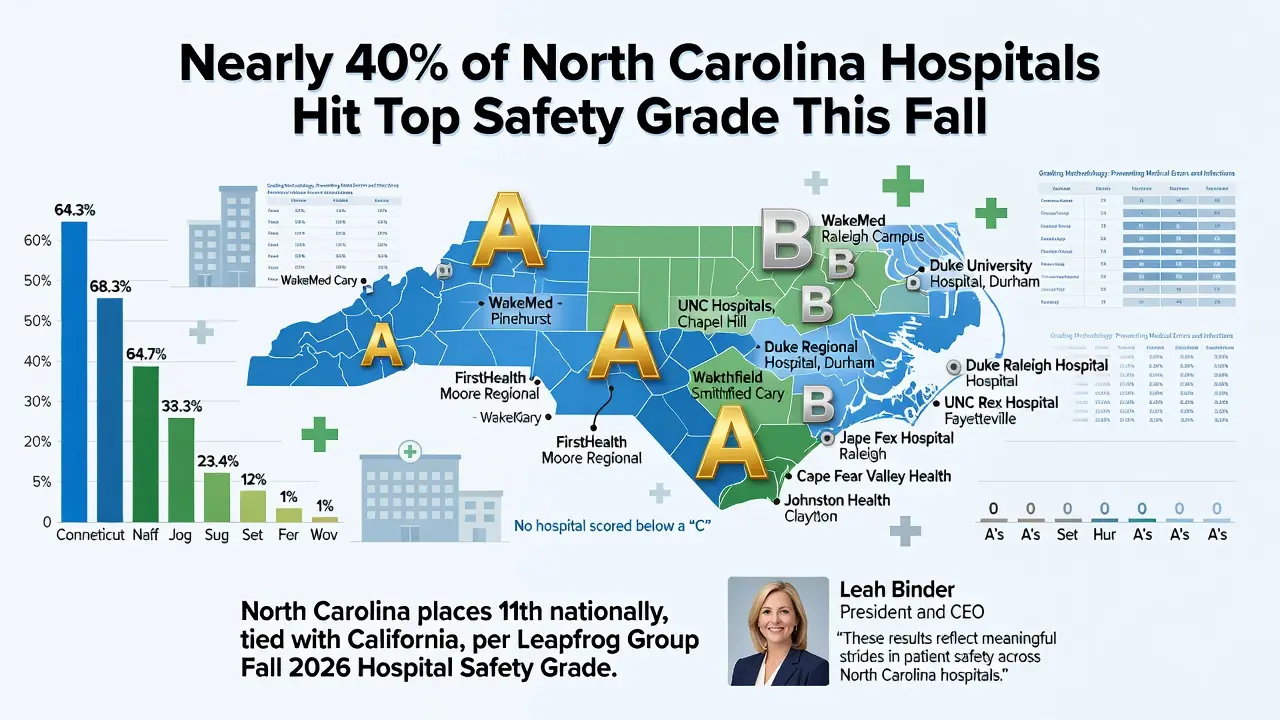
North Carolina placed 11th nationally in the Leapfrog Group's fall 2026 Hospital Safety Grade report, with 38.3% of its hospitals earning an "A" rating, tying the state with California. The result marks a slight slide from spring 2026, when North Carolina ranked eighth with 41.5% of hospitals achieving an "A," though no hospital in the state fell below a "C" grade in either period.
How the grading works
The Leapfrog Group, an independent nonprofit, issues the Safety Grade twice a year, assigning hospitals a letter from "A" to "F" based on their track record in preventing medical errors, infections, accidents and other avoidable harm. The scores draw on publicly reported data and are intended to help patients compare facilities before choosing where to seek care. Leah Binder, the organization's president and CEO, said hospitals nationally are "making meaningful strides in patient safety," while cautioning that performance varies widely and urging consumers to review grades before selecting a hospital.
Where North Carolina stands nationally
Connecticut led the country with 64.3% of its hospitals earning an "A," followed by Utah (55.2%), New Jersey (53.7%), South Carolina (52.9%) and Virginia (52.1%). At the other end of the spectrum, Iowa, North Dakota, South Dakota, Vermont and Wyoming each reported zero "A"-graded hospitals this cycle. North Carolina's 38.3% places it solidly in the upper tier nationally, even after its three-spot drop from the spring report.
Local hospitals by grade
Nine North Carolina hospital campuses received an "A" in the fall 2026 report, including UNC Hospitals in Chapel Hill, WakeMed Raleigh Campus, Duke Regional Hospital in Durham, two Cape Fear Valley Health facilities, two FirstHealth Moore Regional locations, and two Johnston Health campuses. Thirteen additional facilities, among them Duke University Hospital, Duke Raleigh Hospital, UNC Rex Hospital and WakeMed Cary, earned a "B." No North Carolina hospital scored lower than a "C," reinforcing the state's overall above-average standing even amid the modest decline in top-tier grades.
What the grades do and don't tell patients
The Safety Grade is a useful starting point for comparing hospitals, but it reflects a specific set of safety-related measures rather than overall quality of care, outcomes for particular conditions, or patient satisfaction. Patients weighing a hospital choice may want to pair the Safety Grade with other public data sources and conversations with their own physicians, since grades can shift between reporting periods, as North Carolina's statewide figure did between spring and fall 2026.